Executive Summary
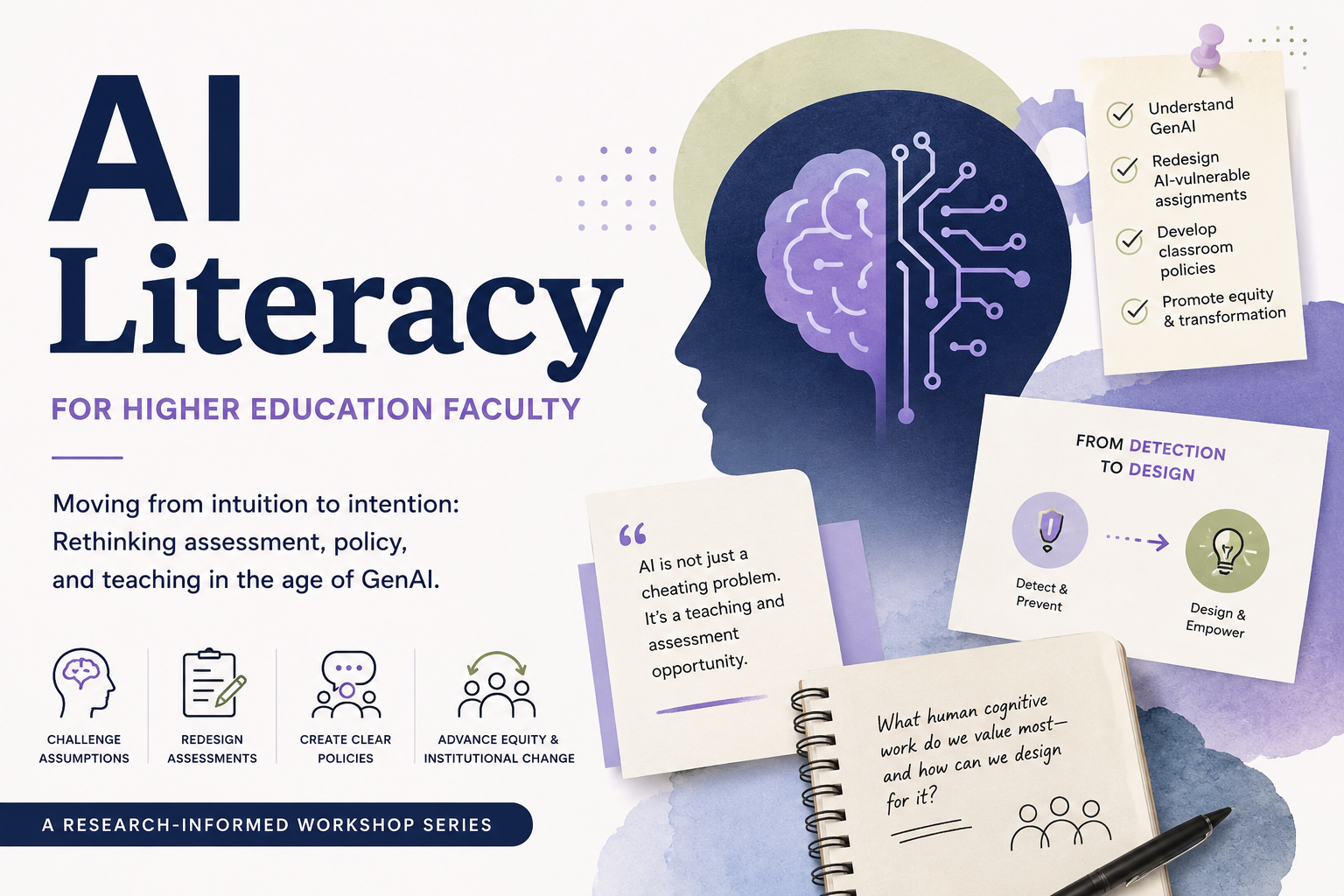
This project addresses the challenge of cognitive offloading and academic integrity in higher education as Generative AI becomes a primary tool for student productivity. Designed for university faculty, the initiative moves beyond traditional surveillance-based detection to focus on intentional assessment redesign.
The core of the intervention is a four-phase curriculum built on a tri-lens theoretical framework:
- •Conceptual Change Theory: Using cognitive dissonance through live AI failure demonstrations (forced hallucinations) to dismantle outdated mental models and create a felt need for new pedagogical strategies.
- •Social Constructivism: Facilitating collaborative sense-making via gallery walks and peer-to-peer policy drafting, allowing faculty to co-construct institutional norms.
- •Metacognitive Scaffolding: Implementing structured journal reflections and synthesis worksheets that force faculty to isolate high-order human cognitive processes, such as judgment and contextual evaluation, that AI cannot reliably replicate.
The project delivered a full institutional plug-and-play suite, including a Strategic Rationale Report, Facilitator Field Guides with scripted talk-tracks for handling faculty skepticism, and Interactive Participant Worksets. The result is not just a technology tutorial but a research-grounded blueprint for sustainable institutional transformation.
01. The Challenge: Bridging the Intuition Gap
Why AI Literacy for Professors?
Higher education faculty often enter the AI conversation with strong but conflicting intuitions, ranging from high anxiety to over-optimism. The core problem identified in this project was not just learning how to use tools, but re-evaluating what "academic integrity" means when cognitive offloading becomes effortless.
The Goal: Move faculty from a mindset of detection and prevention to one of intentional assessment redesign.
02. The Solution: A Four-Phase Arc
From Awareness to Institutional Transformation
I architected a modular, four-workshop series designed to lead faculty through a psychological and pedagogical shift:
- Workshop 1: Foundations & Reflections: Surfacing mental models and confronting the hallucination risks of LLMs through live demonstrations.
- Workshop 2: Assessment Redesign: Moving from "AI-vulnerable" to "AI-resilient" tasks.
- Workshop 3: Policy & Communication: Developing transparent classroom frameworks (Green/Yellow/Red zones) for AI use.
- Workshop 4: Equity & Transformation: Addressing the digital divide and ensuring AI does not widen existing educational inequalities.
03. Design Strategy: Inducing Cognitive Dissonance
Turning Research into Experience
To engage a skeptical academic audience, the design utilised Conceptual Change Theory. Rather than telling faculty that AI is unreliable, I designed experiences where they could see it fail in real time.
- •The "Dolphin" Experiment: A live demo where AI is prompted to explain why dolphins are fish, exposing how confidently LLMs produce false claims.
- •The "Coffee" Hallucination: Forcing the AI to generate fake peer-reviewed citations proving coffee cures anxiety, demonstrating fabrication at the source level.
- •The "Human-in-the-Loop" Worksheet: A structured reflection tool that forces participants to identify which cognitive processes, such as evaluation, judgment, and contextual application, AI cannot replace.
04. Comprehensive Artifact Suite
This project provides a plug-and-play solution for university departments, featuring a full library of implementation materials. Each artifact is designed so that a department head with no prior AI background can run the full workshop series with high fidelity.
- •The Strategic Rationale (Report): A deep dive into the learning science and situational analysis behind the curriculum, grounding the intervention in peer-reviewed theory.
- •Facilitator Field Guide: A sample comprehensive guide for Workshop 1 that empowers any department head or facilitator to lead sessions with high fidelity, including scripted talk-tracks for handling faculty pushback and skepticism.
- •Visual Narrative (PPT): A sample deck for Workshop 1 facilitators featuring 2024 citations on LLM reasoning collapse and truth-verification struggles.
- •Participant Reflection Worksheet: A sample worksheet for Workshop 1 and the "Active Learning" engine of the workshop, facilitating small-group sense-making and assessment redesign.
05. Key Insights & Professional Takeaways
- •Assessment as the Anchor: AI is not a threat to education; it is a threat to outdated assessment. By anchoring the workshop in assessment redesign, we transform faculty anxiety into creative agency.
- •Psychological Safety: Workshop 1 focuses heavily on surfacing intuitions. Before faculty can learn new technology, they must feel that their fears about academic integrity are heard and normalised.
- •Scalability via Documentation: The Facilitator Guide ensures the intervention can be scaled across an entire university without losing the nuances of the pedagogical research.