The question: whose belief is the model tracking?
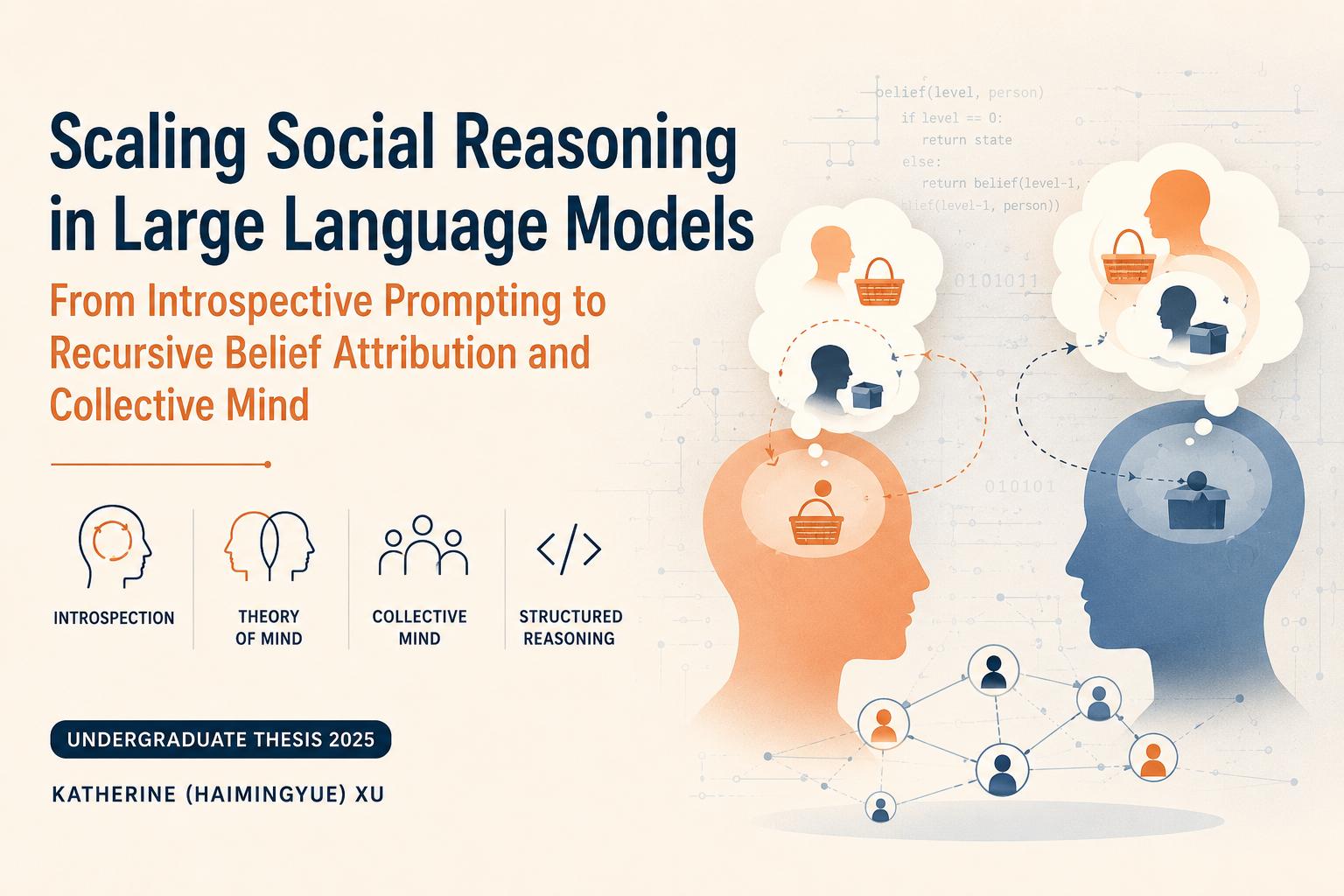
An assistant can sound socially perceptive while losing track of who knows what. My honours thesis examined recursive Theory of Mind: reasoning about nested beliefs, such as one person thinking that another person does not know something.
This matters for products that use AI to teach, advise, or support decisions. A fluent response alone does not establish that the system has tracked the relevant social context.
The experiment
I compared GPT-3.5-turbo and o3-mini through API-based experiments using 1,800 generated scenarios and 10,800+ evaluations. The study varied belief depth and communication conditions, comparing vanilla multiple-choice prompts, Chain-of-Thought, and Program-of-Thought approaches.
Program-of-Thought represented nested beliefs using code-like variables. This gave the model an explicit structure for tracking different people's knowledge states.
What the results showed
On the zero-shot No-Tell subset, o3-mini achieved 82.7% with Program-of-Thought and 81.3% with Chain-of-Thought. This is a result for a specific model and condition, not a blanket accuracy across all tasks or proof of a significant 1.4-point improvement.
Performance varied with belief depth, prompt format, and communication context. The practical finding was that model choice and prompt structure need to be evaluated together for the task a product actually depends on.
Extending the question to groups
A second study explored how relational context affects predictions of group behavior. Scenarios varied emotional valence, power hierarchy, and public versus private visibility in a 3 × 2 × 2 design.
The resulting patterns raised further questions about how models represent relationships. A benchmark response is only one form of evidence; it does not establish reliable reasoning about people in real conversations.
What this changed about my product work
I start by identifying the reasoning a workflow depends on, then look for conditions where that reasoning fails. Structured prompts can help, but the evaluation needs to reflect the product's actual context.
The thesis gave me a way to connect cognitive questions, experiment design, and product decisions. The full thesis and presentation below contain the detailed methods and results.