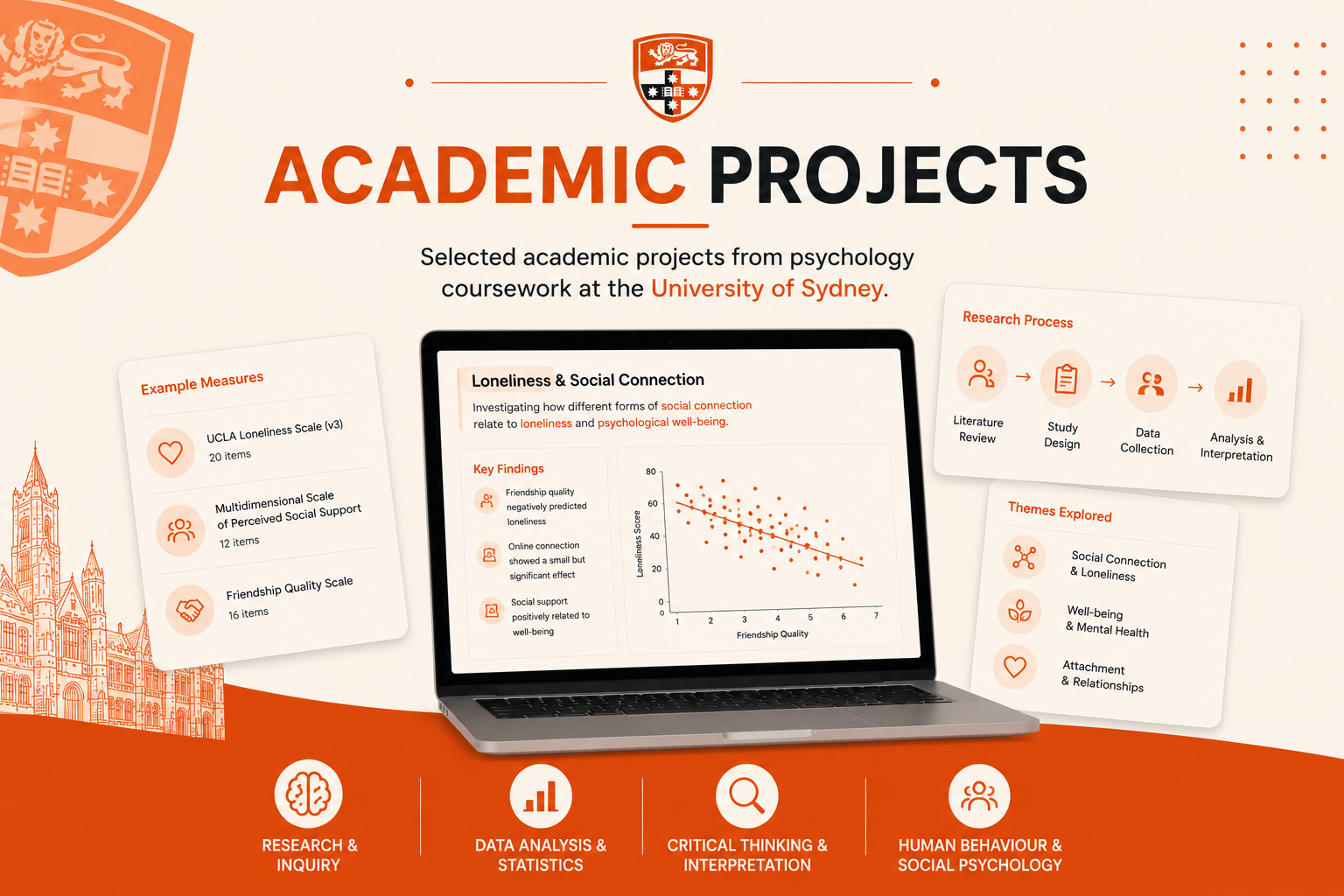
Psychology coursework at the University of Sydney spans four years of undergraduate study, ranging from first-year foundations in cognitive and social psychology to honours-level work in mental health, social media, and clinical intervention. The twelve entries below include experimental lab reports, applied statistics assignments, case study analyses, and argumentative literature reviews, each written for a distinct course across brain and behaviour, quantitative methods, social psychology, and mental health conditions.
PSYC1001 · Introduction to Psychology A
A group lab report investigating the grain size hypothesis as an extension of the well-established testing effect (Wissman & Rawson, 2015). Does chunking study material into smaller segments improve long-term retention when tested one week later?
Participants studied word lists divided into small or large segments, completed math distractor tasks, then returned for a cumulative test one week later. Our redesign, using lower cognitive-load materials and a longer delay, confirmed the hypothesis: smaller sections produced significantly better delayed recall, consistent with finer-grained retrieval practice strengthening long-term memory consolidation.
PSYC1002 · Introduction to Psychology B
A group lab report examining whether disruptive vs non-disruptive protest strategies differ in their effectiveness at shifting attitudes toward a social movement. Veganism served as the test cause, attitudes measured via the Attitude Toward Vegetarians Scale (ATVS) and the 4N Scale (moral foundations framework).
Disruptive vegan protests produced significantly more negative attitudes toward vegans than non-disruptive ones (p = .04). More surprisingly, even the non-disruptive condition generated more negative attitudes than a no-protest control, suggesting drawing attention to the movement may backfire regardless of tone.
PSYC2012 · Statistics and Research Design
A two-part methods assignment. Part 1 involved running an independent samples t-test on a white noise experiment dataset (N = 128), examining effects on executive function and fluid intelligence. Both effects were non-significant: executive function t(126) = −1.55, p = .124; fluid intelligence t(126) = −0.77, p = .442.
Part 2 critically evaluated a published mindfulness intervention study for healthcare worker burnout. The core methodological flaw: the study compared pre- and post-intervention scores using an independent-samples t-test instead of a paired-samples t-test, treating the same participants as independent groups. Additional issues: no control group; only the emotional exhaustion sub-scale of the MBI-HSS was measured. I also proposed a qualitative follow-up question to explore the lived experience dimension.
PSYC2016 · Perception, Cognition, and Intelligence
An individual APA lab report investigating the causes of the anchoring effect: does it arise from anchoring-and-adjustment heuristics, semantic priming, or both? Using a 2×2×2 between-subjects design (memory load × question similarity × anchor size), N = 359 students estimated numerical quantities after exposure to experimenter-provided anchors.
Both anchor size (adjustment heuristic) and question similarity (semantic priming) significantly affected estimates, and their interaction was significant, supporting a dual-process account of anchoring. Memory load had no effect, explained by anchor type: working memory only affects self-generated anchors (which require adjustment), not the experimenter-provided anchors used here.
PSYC2017 · Personality and Social Psychology
An individual APA lab report examining how openness to experience (Big Five) and group salience interact during vicarious intergroup contact to reduce prejudice toward the Chinese diaspora in Australia. N = 297 Anglo-European students read a scenario involving an Anglo-European and Chinese student collaborating.
High group salience produced significantly lower prejudice, consistent with the Mutual Intergroup Differentiation Model (MIDM). Crucially, low-openness individuals benefited more from high group salience than high-openness individuals, a reversal of the expected pattern, possibly because only specific openness facets (values, feelings, fantasy) relate to intergroup attitudes.
PSYC2915 · Brain and Behavioural Psychology (Advanced)
A lab report investigating higher-order conditioning in allocentric spatial navigation using a virtual Morris Water Maze. Can participants learn a chained association (A predicts B, B predicts the chest location) and then locate the target using landmark A alone, without ever directly experiencing the A-to-chest relationship?
Both groups improved significantly across training (F(1, 286) = 113.003, p < .001), validating spatial learning in the virtual environment. However, no significant group difference emerged in the critical Test A phase (t(30) = −2.340, p = .27), leaving the higher-order conditioning hypothesis unsupported, likely because simultaneous multi-landmark arrays prevented clear A→B association formation.
PSYC3010 · Psychological Research Methods III: Solitude & Mood
A quantitative lab report examining how solitude duration interacts with extroversion to predict mood. 96 participants were assigned to one of four "me-time" conditions (short: <3 h, moderate: 3–7 h, long: 7–24 h, prolonged: 24+ h) and assessed on personality (BFI) and mood (Mood Introspection Scale, 0–50).
Planned contrasts (Bonferroni-corrected) found moderate-duration solitude produced significantly better mood than all other conditions (F(1, 88) = 10.221, p = .002, ηp² = .104). A significant interaction also emerged: extroverts showed steeper mood gains with increasing duration but sharper decline in the prolonged condition relative to introverts (F(1, 88) = 7.222, p = .009, ηp² = .076).
PSYC3010 · Psychological Research Methods III: Multiple Regression
An applied statistics assignment predicting educational functioning during university transition (N = 179 first-year psychology students). Five predictors were tested: mental toughness, substance use coping, instrumental support seeking, conscientiousness, and sleep disturbances.
The overall model was significant (R² = .372, F(5, 173) = 20.476, p < .001). Mental toughness was the strongest predictor (β = .484, p < .001): each SD increase in resilience predicted a 0.484 SD increase in educational functioning. Substance use coping was the only other significant predictor (β = −.191, p < .05). The assignment also required identifying errors in simulated student output, distinguishing standardised betas from unstandardised coefficients.
PSYC3017 · Social Psychology: Social Media & Loneliness
An empirical report written to journal submission standards, investigating whether social media platform type and weekly usage intensity jointly predict loneliness. Grounded in the displacement and stimulation hypotheses, and Sundar's (2008) MAIN model, the study tested image-based vs text-based platforms × high vs low usage, a 2×2 interaction not previously examined in the literature.
High weekly users reported significantly greater loneliness than low users (H2 supported). Critically, a significant interaction emerged (H3 supported): high-frequency users of text-based platforms reported greater loneliness than those on image-based platforms, suggesting that low-cue environments fail to meet the social-emotional needs of heavy users.
PSYC3018 · Mental Health Conditions: Mindfulness for GAD
A two-part clinical essay. Part I presented a preliminary DSM-5-TR diagnosis of Generalised Anxiety Disorder for case study client "Rami", ruling out OCD and Illness Anxiety Disorder based on DASS-21 scores, behavioural observations, and symptom mapping.
Part II critically evaluated MBSR and MBCT for GAD. Meta-analyses show moderate effectiveness (Hedges' g = −0.65), but methodological limitations (small samples, self-report bias, inadequate fidelity monitoring) constrain confidence. For Rami, MBCT was recommended as a complement to CBT given his cognitive features (rumination, catastrophic thinking); MBSR as support for physiological stress. CBT remains the first-line treatment.
PSYC3018 · Mental Health Conditions: CBT for Social Anxiety Disorder
A critical essay evaluating the empirical literature supporting CBT as the best available treatment for Social Anxiety Disorder (SAD). Evidence was synthesised from major RCTs and network meta-analyses (Mayo-Wilson et al. (2014), Carpenter et al. (2018), Hofmann & Smits (2008)) demonstrating CBT's consistent superiority over pharmacological and other psychological interventions.
Limitations in the evidence base include short-term follow-up with demographically homogeneous samples (predominantly white adults), self-report outcome bias, and underpowered comparisons across delivery formats. The essay concluded CBT remains the established first-line treatment for SAD, while identifying gaps in long-term and cross-cultural research.
PSYC3020 · Advanced Health Psychology: Digital Mindfulness in Prisons
An argumentative essay evaluating whether digital mindfulness programs should be implemented in prisons for rehabilitation and well-being, written as a policy recommendation for Corrective Services NSW. Evidence reviewed spans transcendental meditation (La Tuna Federal Penitentiary), MBSR, Vipassana, and digital apps (VGZ Mindfulness Coach, Smiling Mind, Headspace).
Digital mindfulness apps can replicate in-person benefits at lower cost, reducing depression, anxiety, and recidivism when structured with alerts and inmate-suitability screening. Low adherence and long-term sustainability remain concerns. DBT was recommended for self-harm risk; yoga for depression; digital CBT as a complementary option when standard mindfulness is inappropriate.